Metaphorical Criticism
Metaphorical Criticism of Political Cartoons Depicting Donald Trump
Wilson W. Ahrens
Department of Communication, Old Dominion University
COMM 335W: Rhetorical Criticism
Dr. Frances Hassencahl
October 2, 2026
Metaphorical Criticism of Political Cartoons Depicting Donald Trump
Donald Trump was the most prominent figure across the cartoons recently published on Cagle. He was repeatedly portrayed through visual metaphors in response to his current political controversies. Cartoonists condensed complex situations into accessible images for audiences, and in this way, political cartoons provide an entry point into political discourse and create a shared perspective that helps foster a collective consciousness surrounding important events (Hart & Hassencahl, 2005, p. 88). Foss has us consider what a metaphor highlights, how flattening context may contribute to the omission of details important for collective understanding, and the persuasive effects of those decisions (Foss, 2026, pp. 282–285, 289). The same capacity that allows cartoons to create a shared perspective can also narrow that perspective by constructing a political figure as an enemy.
Hart and Hassencahl (2005) operationalized Keen’s enemy categories in their analysis of editorial cartoons depicting Saddam Hussein during the buildup to the invasion of Iraq. They argued that the cartoons’ visual metaphors helped legitimize the invasion by dehumanizing Hussein into a threat who needed to be stopped (pp. 96–97). Trump is different. Unlike the wartime enemies studied by Keen (as cited in Hart & Hassencahl, 2005, p. 87) and by Hart and Hassencahl, he is not an external enemy of the American state; he occupies its highest political office. Still, the cartoons construct Trump as an existential enemy and often use visual metaphors that fit well into Keen’s enemy categories.
Using Foss’s (2026, pp. 285–289) procedure for metaphorical criticism, I identified the primary visual metaphors in 12 cartoons and extended Keen’s enemy categories, as operationalized by Hart and Hassencahl (2005, pp. 87–92), to cartoons depicting Trump. This analysis asks: Using Keen’s categories, how is Donald Trump framed as an internal political enemy, and how do those metaphors work to delegitimize and rhetorically neutralize his political authority? I argue that recurring portrayals of Trump primarily as a criminal, aggressor, and barbarian make the potential consequences of his actions immediately legible. Portrayals of Trump as greedy, as a desecrator of civilians, as death, and as an enemy of God deepen and support those primary characterizations and help to separate Trump’s possession of presidential authority from the legitimacy of the state by painting him as personally unsuited for the office.
Metaphorical Criticism and Keen’s Categories
Many view figurative language as decoration for speech, but metaphors do much more rhetorically than that view gives them credit for; they frame perceptions of reality and make arguments about how that reality should be understood (Foss, 2026, pp. 281–285). Metaphorical criticism examines those messages by trying to understand one subject through characteristics borrowed from another. Foss (2026) calls the subject that is being explained the tenor and the comparison used to explain it the vehicle. Characteristics associated with the vehicle are transferred to the tenor, emphasizing some qualities of the subject while suppressing others.
I analyzed each cartoon to identify its tenors, vehicles, and transferred characteristics. After isolating the visual metaphors in the selected cartoons and determining the tenors and the vehicles, patterns began to emerge. Foss asks the critic to consider what these messages highlight or conceal via associated commonplaces and the worldview they encourage audiences to accept (Foss, 2026, pp. 285–289). What is substituted for what? What ideas are fused through the metaphorical associations? What does juxtaposing the tenor and vehicle expose?
I supplement Foss’s procedure with Keen’s enemy-image categories, as presented and operationalized by Hart and Hassencahl (2005), to analyze these patterns. Keen derived these categories from historical wartime imagery. The categories are enemy-as-animal, enemy-as-desecrator-of-civilians, enemy-as-torturer-of-prisoners, enemy-as-barbarian, enemy-as-criminal, enemy-as-greedy, enemy-as-enemy-of-God, enemy-as-death, enemy-as-faceless, enemy-as-aggressor, enemy-as-abstraction, and enemy-as-human (Hart & Hassencahl, 2005, pp. 87–92). I adapt the categories for application to an internal political enemy and identify those extensions and explain my rationale for them throughout the analysis.
Rhetorical Context and Artifacts
The artifacts are 12 editorial cartoons published on Cagle between September 11 and 15, 2026, by nine cartoonists. They were selected because each depicts Trump and contains explicit visual metaphors referencing real-world news.
Seven cartoons respond primarily to the upcoming midterm elections. Figure 1 came after the Supreme Court’s rejection of Trump-backed restrictions on mail-in voting (Whitehurst, 2026). Figures 2, 3, and 4 refer to Trump’s promise of $5,000 payments if Republicans won the midterms, which made the payments contingent on a Republican electoral victory (Ramirez Uribe, 2026). Figures 5 and 6 appeared amid warning signs for Republicans as the midterm campaign entered its final stage and questions about whether centering Trump would hurt or help the party (Ax, 2026; Reid, 2026). Figures 7, 8, and 9 respond to controversies surrounding Trump’s use of presidential authority. Figures 7 and 8 refer to presidential orders renaming the Gulf of Mexico as the Gulf of America and Lake Ontario as Lake America (The White House, 2025, 2026), with Figure 7 fusing Sharpiegate, a 2019 controversy in which Trump displayed an altered hurricane forecast map without a scientific basis (PBS NewsHour, 2019), with newer controversies. Trump’s dismissal of concerns about AI risks provides the context for Figure 9 (Boak, 2026).
Figures 10 and 11 concern the conflict with Iran and the struggle over the Strait of Hormuz. By August 2026, reopening the strait had become a major American objective, while reporting suggested that an agreement might require Trump to compromise with Iran (Finley & Lee, 2026; Price, 2026). Finally, Figure 12 refers to Trump asking a convention crowd to raise their hands and repeat a pledge that included a promise to “cheat like hell” (PBS NewsHour, 2026). The cartoon references the Nazi salute used by those loyal to Hitler (United States Holocaust Memorial Museum, n.d.), transferring judgments about Hitler to Trump. All these cartoons were published against the backdrop of highly publicized criminal cases involving Trump (Malig & Abovyan, 2025).
I performed a quantitative analysis of Keen’s categories across the cartoons to develop an overarching explanation of how the metaphors work together to construct an internal political enemy. Table 1 summarizes the frequency of each Keen classification across the collection.
Table 1 - Frequency of Keene's Categories Across the Cartoons
Trump was never directly depicted as an animal or a torturer of prisoners. No cartoon qualified as enemy-as-human because every depiction of Trump had at least one other enemy classification attributed to it. In Figure 12, the crowd extends Trump’s political power as faceless, but Trump is present as an individual; therefore, I did not apply enemy-as-faceless to him. I did, however, classify Trump as enemy-as-death in Figure 5 because he is literally depicted as the ball and chain dragging the Republican elephant toward an implied death. Unlike the faceless crowd in Figure 12, Trump’s likeness is directly embodied by the ball and chain in Figure 5. Although the cartoons address different controversies, they repeatedly translate Trump’s actions and policies into judgments about Trump himself and distinguish him from the institutional authorities and civic values that the cartoons present as legitimate.
Metaphorical Constructions of Donald Trump
Trump as Criminal and Greedy
Enemy-as-criminal is the most common category in the collection, appearing in eight of the 12 cartoons. Enemy-as-greedy appears four times. They are coupled because every cartoon that depicts Trump as greedy also portrays him as criminal, although criminality appears elsewhere without greed. Together, the categories frame Trump’s use of political authority and public money as corrupt attempts to exert ownership over public institutions.
Figure 2 makes this argument through the visual of organized crime. The overlay text reads, “The sycophants of the day waiting for the 5 thousand dollars.” Trump’s use of public money to secure political loyalty is the tenor, while the vehicle is a mobster distributing money to people on his books. Trump wears a blue pinstripe suit and towers over depictions of Netanyahu, Zelenskyy, and Milei, with wads of cash stuffed into his coat pockets. The pinstripe suit invokes the American Mafia, while the cash suggests money acquired outside legitimate channels. These commonplaces transfer criminality and bribery onto Trump. By redirecting Trump’s $5,000 proposal (Ramirez Uribe, 2026) from voters to sycophantic leaders, the cartoon highlights a pattern across Trump’s foreign and domestic policies: offering cash for loyalty.
Figure 7 expands greed beyond money. The tenor is Trump’s attempt to rename established places, while the vehicle is an owner marking his personal property. Trump stands on the globe, a visual of domination, and uses a black Sharpie to cross out “Earth” and replace it with “Trump.” Naming is highlighted as a form of coercive ownership, and the metaphor transfers greed and disregard for shared spaces onto Trump.
Other cartoons extend those characterizations. Figures 3 and 4 frame the $5,000 proposal as an electoral bribe and depict the public treasury as Trump’s personal Scrooge McDuck–style treasure trove. Figure 8 repeats Figure 7’s metaphor by showing Trump writing “America” across the globe. Figures 1, 6, and 12 extend criminality by portraying Trump’s policies as attacks on democracy that undermine legitimate systems. Together, these metaphors highlight Trump’s actions and presumed personal motives while suppressing distinctions among conduct that is criminal, unethical, manipulative, or just controversial. The cartoons do not resolve those distinctions. Those distinctions become the core of the discourse, shaping where audiences draw the line between criminality and the valid use of office.
Trump as a Barbarian, an Aggressor, and a Desecrator of Civilians
Enemy-as-barbarian and enemy-as-aggressor each appear in seven cartoons, while enemy-as-desecrator-of-civilians appears in four. These categories translate Trump’s political actions into physical force and portray him as unintelligent, brutish, and incapable of controlling the political power he possesses.
Figure 1 combines all three categories. The tenor is Trump’s attempt to restrict mail-in voting, while the vehicle is a caveman trying to smash an object with a club. His unbuttoned shirt, ridiculously long tie, orange coloring, awkward posture, and poor balance give him an oafish, incapable demeanor. The club transfers primitiveness and brutish force onto Trump, making him both barbarian and aggressor. A man wearing a robe marked “Supreme Court” physically restrains him, suggesting that Trump presents an immediate danger that can only be stopped by intervention. An eclipse and circling birds create an ominous final-hour feeling, while a white dove delivers the mail in a Hail Mary fulfillment of justice. Because the physical attack represents coercing the public to accept voting restrictions and attacking citizens’ autonomy to participate in democracy, the cartoon also constructs Trump as a desecrator of civilians.
Figure 12’s analysis contains similar logic. The tenor is MAGA’s personal loyalty to Trump, while the vehicle is Nazi Party loyalty to Hitler. Trump directs supporters to raise their right hands and repeat after him. Their uniform red clothing, outstretched arms, and lack of individualized faces turn them into a faceless extension of Trump’s influence. The raised-arm salute transfers authoritarian loyalty onto Trump, making him both an aggressor and a barbarian. He also becomes a desecrator of civilians because the crowd’s civic identity and political independence have been replaced by allegiance to him. This application extends enemy-as-desecrator-of-civilians beyond Keen’s original wartime setting. Hart and Hassencahl (2005) operationalized the category through physical or psychological harm, intimidation, and repression directed at civilians. Here, that harm occurs through the manipulation of American voters’ independence, democratic participation, and national allegiance.
The remaining cartoons repeat these constructions through different vehicles. Figures 3 and 4 complete the desecrator pattern by portraying the proposed payments as financial and psychological leverage over American voters. Figure 6 arms Trump with a bat labeled “Midterms,” suggesting that he is weaponizing the American political system. Figure 9’s barbarism appears in the label “Mr. No Intelligence,” while its juxtaposition attaches the robot’s aggression to Trump by portraying his denial as enabling harm. Figures 7 and 8 portray Trump’s renaming of shared places as an aggressive imposition, while Figure 7’s exaggerated features additionally characterize him as barbaric. Figures 10 and 11 depict him as half-dressed, off-kilter, and incapable of handling international conflict. In Figure 10, he carries a big stick that is sliced in half, poking fun at his ability to negotiate. The repeated tension is that Trump is portrayed as unintelligent and incapable while remaining powerful enough to threaten elections, institutions, citizens, political parties, and international stability.
Trump as an Abstraction, as Death, and an Enemy of God
Enemy-as-abstraction and enemy-as-death each appear once, in Figure 5, while enemy-as-enemy-of-God appears in Figures 10 and 11. Although these categories appear less frequently, their metaphors are intense. They present Trump as a destructive political force and a false prophet.
In Figure 5, Trump becomes a ball and chain dragging the Republican Party’s elephant mascot toward the bottom of the ocean. The tenor is Trump’s effect on the Republican Party, while the vehicle is a dead weight drowning its victim. This is the clearest fusion metaphor in the collection because Trump’s head is literally incorporated into the weighted ball. It is also the only cartoon coded as enemy-as-abstraction. I extend enemy-as-death beyond Keen’s literal skeletal imagery (Hart & Hassencahl, 2005, pp. 87–92) because the object Trump is depicted as implies death by drowning. The elephant’s thought bubble says “If only I could let go…” This highlights the Republican Party’s continued attachment to Trump despite the destructive forces attributed to him, while also suppressing what Republicans might consider successes under him that help explain that attachment.
In Figure 10, the Ayatollah slices Trump’s stick in half. In Figure 11, he lassos Trump and drags him past a rock labeled “Hormuz.” I extend enemy-as-enemy-of-God to Figures 10 and 11 because they depict Trump as a false prophet. The shared tenor is Trump’s presentation of himself as a righteous and heroic leader, while the vehicles are an incompetent performer hanging on for his life and a false savior who relies on smoke and mirrors. Trump appears to walk on water but is only skidding across the water in green sandals while holding an artificial halo above his own head. His exposed body, horrified expression, and silly cape turn religious and heroic imagery into comedy. Trump is portrayed as appropriating Christian imagery to manufacture moral authority for conduct that is self-serving. Figures 10 and 11 also retain traditional external enemies. The Ayatollah is depicted as an armed aggressor, while Putin, Xi Jinping, Kim Jong Un, and a Houthi rebel appear as antagonistic or opportunistic figures surrounding Trump. Trump, however, is not shown as a capable leader defending the state from them. He is pulled into the conflict and humiliated. Together, Figures 5, 10, and 11 reduce Trump to two destructive political functions: a dead weight dragging down his party and a false savior dragging the country through a conflict he cannot control.
Conclusion
Hart and Hassencahl (2005) found that enemy imagery echoed the president’s framing of an external threat and helped legitimize war against it (pp. 96–97). Here, I turn that analysis inward by extending Keen’s wartime enemy categories to Donald Trump, a sitting president. This inversion sheds light on how the cartoonists challenge Trump’s legitimacy through their use of visual metaphors.
How does an audience distinguish between a proposed payment and a bribe? How does one determine whether a policy protects the democratic process or directly attacks voting rights? Cartoons attempt to offer an explanation, though one filtered through the cartoonist’s lens. Foss explains how metaphors produce judgments like those constructed in these cartoons (Foss, 2026, pp. 282–289). This analysis does not determine whether those judgments are fair; it provides context and examines how visual metaphors produce those judgments. Metaphors make the consequences of Trump’s decisions visible and immediately legible while suppressing policy details and leaving questions of legality unanswered. They often compress real behavior that may be criminal, unethical, manipulative, or merely controversial into one valuation of Trump. That compression is the source of the cartoons’ accessibility and the basis of their persuasive argument, as well as the grounds on which opponents may criticize the characterizations as unfair.
Criminal, aggressive, and barbaric portrayals are supported across the collection by themes of greed and the desecration of civilians. Trump is abstracted into an existentially destructive force and compared to a false prophet. The institutions positioned against him are presented as legitimate restraints on his power. Through visual metaphors, the cartoons separate Trump’s possession of presidential power from the legitimate exercise of that power, making resistance an act of restoring political order. This framing condemns Trump while reaffirming the larger political system. My analysis is limited to a sample of 12 explicitly critical cartoons published over five days and cannot determine their effects on audiences without further audience research. However, Hart and Hassencahl (2005) argue that political cartoons contribute to public discourse by creating shared perspectives and potentially fostering a collective consciousness about events (p. 88), while Foss explains that audiences accept a metaphorical argument only when they accept its associated commonplaces and the connection between tenor and vehicle (Foss, 2026, p. 284). If viewers reject that connection, they may instead perceive the cartoon as unfair. With that in mind, I argue that, for viewers who already regard Trump as a threat, these metaphors reinforce the beliefs that he is unsuited for office and that continued resistance is necessary.
References
Ax, J. (2026, September 7). Warning signs abound for Trump’s Republicans as midterm campaign begins final sprint. Reuters. https://www.reuters.com/legal/government/warning-signs-abound-trumps-republicans-midterm-campaign-begins-final-sprint-2026-09-07/
Becs. (2026, September 14). Leaders await payment [Editorial cartoon]. Cagle Cartoons. https://cagle.com/cartoonist/becs/2026/09/14/311083/leaders-await-payment
Boak, J. (2026, September 14). Trump calls AI risks a “hoax,” says there is a “SICK conspiracy” against AI and data centers. Associated Press. https://apnews.com/article/b85df16775ff7e9611a456b061a0e4b9
Finley, B., & Lee, M. (2026, August 7). A deal with Iran over the Strait of Hormuz may require a compromise from Trump. PBS NewsHour. https://www.pbs.org/newshour/world/a-deal-with-iran-over-the-strait-of-hormuz-may-require-a-compromise-from-trump
Foss, S. K. (2026). Rhetorical criticism: Exploration and practice (6th ed.). Waveland Press.
Francisco, M. (2026, September 13). Trump promises money for Republican votes [Editorial cartoon]. Cagle Cartoons. https://cagle.com/cartoonist/manny-francisco/2026/09/13/311049/trump-promises-money-for-republican-votes
Hart, W. B., II, & Hassencahl, F. (2005). Culture as persuasion: Metaphor as weapon. In L. Artz & Y. R. Kamalipour (Eds.), Bring ’em on: Media and politics in the Iraq War (pp. 85–100). Rowman & Littlefield.
Kamensky, M. (2026a, September 13). Armageddon comedy [Editorial cartoon]. Cagle Cartoons. https://cagle.com/cartoonist/marian-kamensky/2026/09/13/311044/armageddon-comedy
Kamensky, M. (2026b, September 14). Losses at Hormuz [Editorial cartoon]. Cagle Cartoons. https://cagle.com/cartoonist/marian-kamensky/2026/09/14/311052/losses-at-hormus
Kamensky, M. (2026c, September 15). Horror midterms for Trump [Editorial cartoon]. Cagle Cartoons. https://cagle.com/cartoonist/marian-kamensky/2026/09/15/311090/horror-midterms-for-trump
Komarnitski, C. (2026, September 15). Trump rebrands planet Earth [Editorial cartoon]. Cagle Cartoons. https://cagle.com/cartoonist/christo-komarnitski/2026/09/15/311091/trump-rebrands-planet-earth
Koterba, J. (2026, September 14). Trump renames the world [Editorial cartoon]. Cagle Cartoons. https://cagle.com/cartoonist/jeff-koterba/2026/09/14/311085/trump-renames-the-world
Listes, N. (2026, September 14). Uncle Trump is handing out dollars [Editorial cartoon]. Cagle Cartoons. https://cagle.com/cartoonist/nikola-listes/2026/09/14/311067/uncle-trump-is-handing-out-dollars
Malig, K., & Abovyan, K. (2025, January 21). A guide to the criminal cases against Donald Trump. FRONTLINE. https://www.pbs.org/wgbh/frontline/article/a-guide-to-the-criminal-cases-against-donald-trump/
McKee, R. (2026, September 11). Trump pledge [Editorial cartoon]. Cagle Cartoons. https://cagle.com/cartoonist/rick-mckee/2026/09/11/311030/trump-pledge
PBS NewsHour. (2019, September 4). Watch: Trump uses altered, week-old map in briefing to falsely show Alabama was in Dorian’s path [Video]. https://www.pbs.org/newshour/nation/watch-trump-says-u-s-is-well-prepared-for-hurricane-dorian
PBS NewsHour. (2026, September 11). Watch: Trump leads RNC in pledge to “cheat like hell” in November elections [Video]. https://www.pbs.org/newshour/politics/watch-trump-leads-rnc-in-pledge-to-cheat-like-hell-in-november-elections
Price, M. L. (2026, August 27). U.S. goals have shifted after 6 months of Iran war. The Strait of Hormuz is now a top concern. Associated Press. https://apnews.com/article/bb91832b61fa98fe12790d0a887719e0
Ramirez Uribe, M. (2026, September 10). Trump promised $5,000 checks if Republicans win the midterms. How would that work? PBS NewsHour. https://www.pbs.org/newshour/politics/trump-promised-5000-checks-if-republicans-win-the-midterms-how-would-that-work
Reid, T. (2026, September 11). Five big takeaways from Trump’s midterm convention. Reuters. https://www.reuters.com/world/us/five-big-takeaways-trumps-midterm-convention-2026-09-11/
United States Holocaust Memorial Museum. (n.d.). Making a leader. Holocaust Encyclopedia. https://encyclopedia.ushmm.org/content/en/article/making-a-leader
van Leeuwen, B. (2026a, September 14). Trump calls AI risks a hoax [Editorial cartoon]. Cagle Cartoons. https://cagle.com/cartoonist/bart-van-leeuwen/2026/09/14/311087/trump-calls-ai-risks-a-hoax
van Leeuwen, B. (2026b, September 14). Trump targets Democrats with midterms [Editorial cartoon]. Cagle Cartoons. https://cagle.com/cartoonist/bart-van-leeuwen/2026/09/14/311057/trump-targets-democrats-with-midterms
Weyant, C. (2026, September 14). GOP sinking fast [Editorial cartoon]. Cagle Cartoons. https://cagle.com/cartoonist/christopher-weyant/2026/09/14/311079/gop-sinking-fast
The White House. (2025, January 20). Restoring names that honor American greatness. https://www.whitehouse.gov/presidential-actions/2025/01/restoring-names-that-honor-american-greatness/
The White House. (2026, August 27). Honoring the American history of the Great Lakes and renaming Lake Ontario as Lake America. https://www.whitehouse.gov/presidential-actions/2026/08/honoring-the-american-history-of-the-great-lakes-and-renaming-lake-ontario-as-lake-america-3a36/
Whitehurst, L. (2026, September 14). Supreme Court rejects Trump mail ballot restrictions ahead of midterms. Associated Press. https://apnews.com/article/78a4fbeb48d9c5fd27d1c865529fc65f
Figure 1
Horror Midterms for Trump
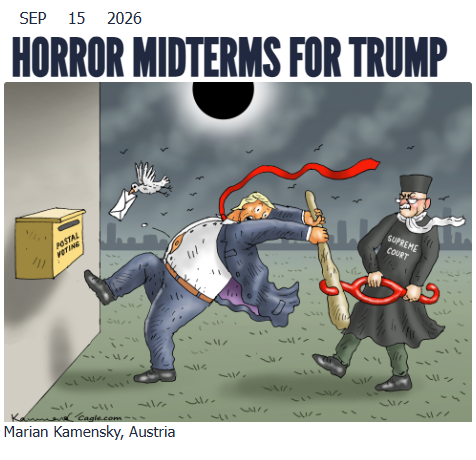
Note. From Horror Midterms for Trump [Editorial cartoon], by M. Kamensky, 2026c, Cagle Cartoons (https://cagle.com/cartoonist/marian-kamensky/2026/09/15/311090/horror-midterms-for-trump). Copyright 2026 by Marian Kamensky.
Figure 2
Leaders Await Payment
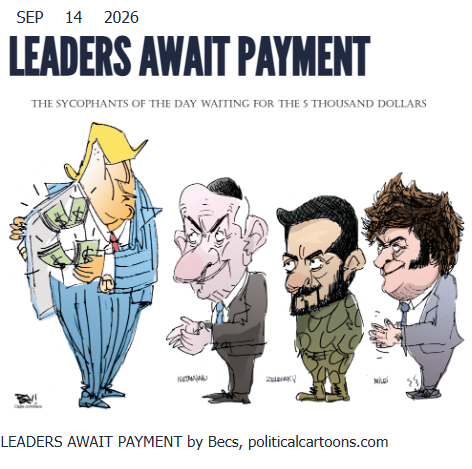
Note. From Leaders Await Payment [Editorial cartoon], by Becs, 2026, Cagle Cartoons
(https://cagle.com/cartoonist/becs/2026/09/14/311083/leaders-await-payment).
Copyright 2026 by Becs.
Figure 3
Trump Promises Money for Republican Votes
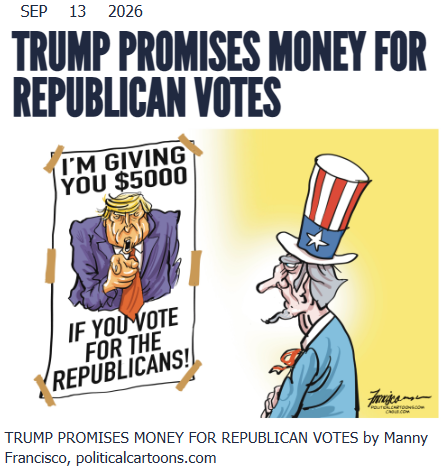
Note. From Trump Promises Money for Republican Votes [Editorial cartoon], by M. Francisco, 2026, Cagle Cartoons
Copyright 2026 by Manny Francisco.
Figure 4
Uncle Trump Is Handing Out Dollars
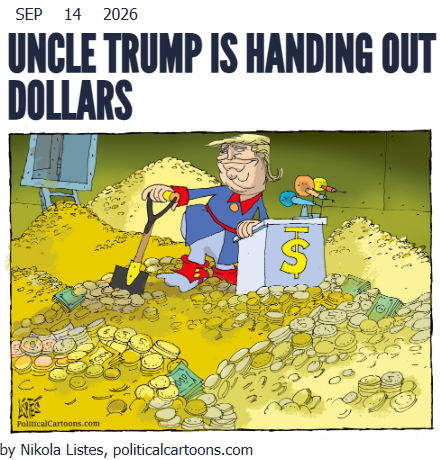
Note. From Uncle Trump Is Handing Out Dollars [Editorial cartoon], by N. Listes, 2026, Cagle Cartoons
(https://cagle.com/cartoonist/nikola-listes/2026/09/14/311067/uncle-trump-is-handing-out-dollars).
Copyright 2026 by Nikola Listes.
Figure 5
GOP Sinking Fast
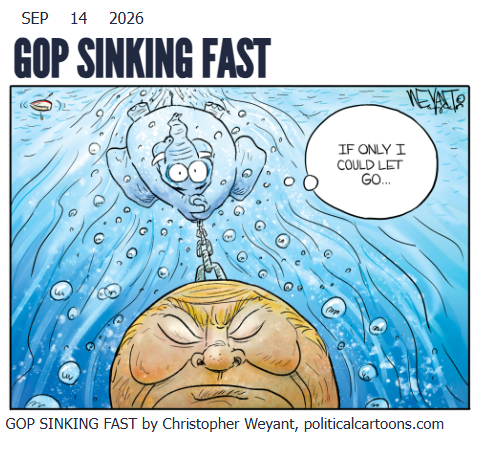
Note. From GOP Sinking Fast [Editorial cartoon], by C. Weyant, 2026, Cagle Cartoons
(https://cagle.com/cartoonist/christopher-weyant/2026/09/14/311079/gop-sinking-fast).
Copyright 2026 by Christopher Weyant.
Figure 6
Trump Targets Democrats With Midterms
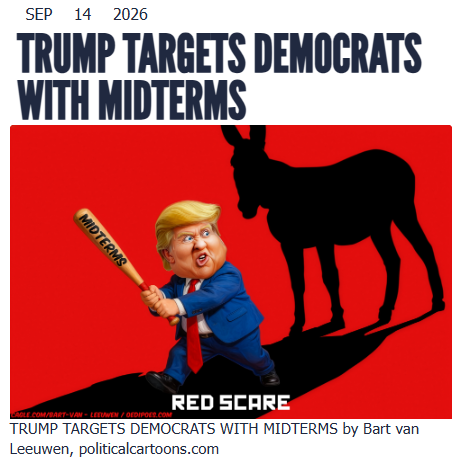
Note. From Trump Targets Democrats With Midterms [Editorial cartoon], by B. van Leeuwen, 2026b, Cagle Cartoons
Copyright 2026 by Bart van Leeuwen.
Figure 7
Trump Rebrands Planet Earth
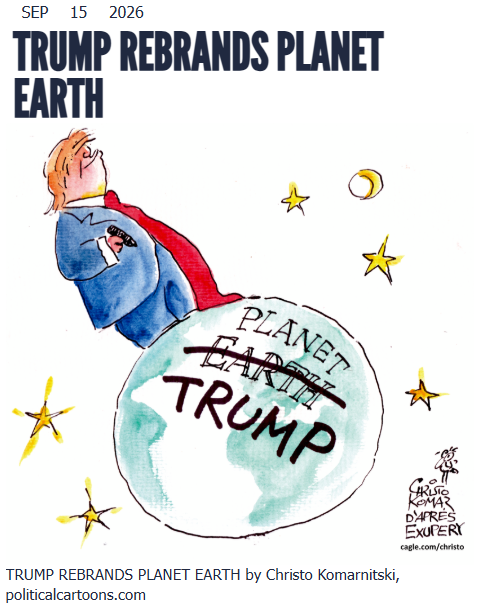
Note. From Trump Rebrands Planet Earth [Editorial cartoon], by C. Komarnitski, 2026, Cagle Cartoons
(https://cagle.com/cartoonist/christo-komarnitski/2026/09/15/311091/trump-rebrands-planet-earth).
Copyright 2026 by Christo Komarnitski.
Figure 8
Trump Renames the World
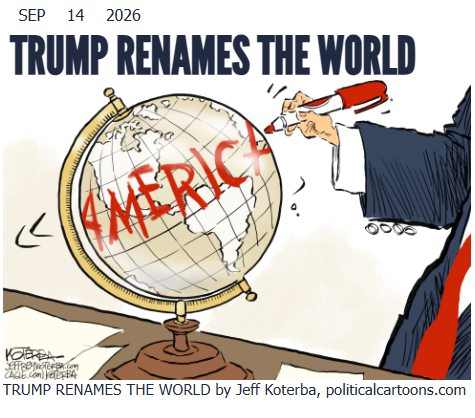
Note. From Trump Renames the World [Editorial cartoon], by J. Koterba, 2026, Cagle Cartoons
(https://cagle.com/cartoonist/jeff-koterba/2026/09/14/311085/trump-renames-the-world).
Copyright 2026 by Jeff Koterba.
Figure 9
Trump Calls AI Risks a Hoax
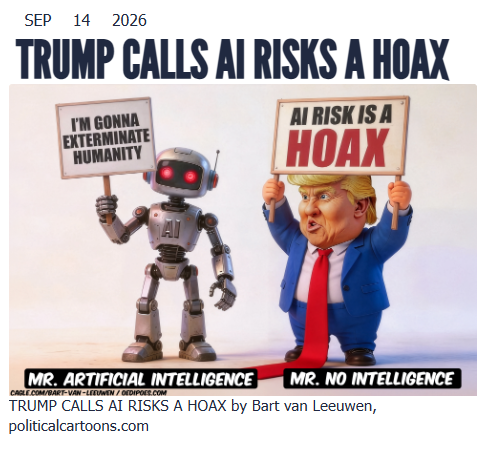
Note. From Trump Calls AI Risks a Hoax [Editorial cartoon], by B. van Leeuwen, 2026a, Cagle Cartoons
(https://cagle.com/cartoonist/bart-van-leeuwen/2026/09/14/311087/trump-calls-ai-risks-a-hoax).
Copyright 2026 by Bart van Leeuwen.
Figure 10
Armageddon Comedy
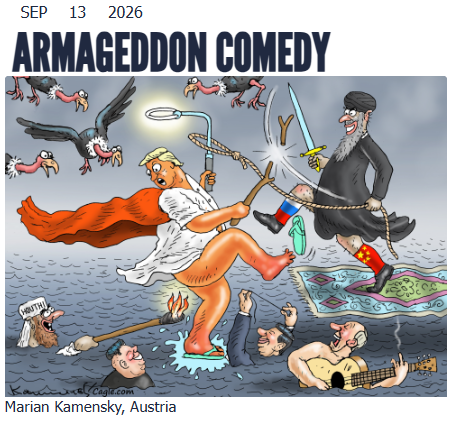
Note. From Armageddon Comedy [Editorial cartoon], by M. Kamensky, 2026a, Cagle Cartoons
(https://cagle.com/cartoonist/marian-kamensky/2026/09/13/311044/armageddon-comedy).
Copyright 2026 by Marian Kamensky.
Figure 11
Losses at Hormuz
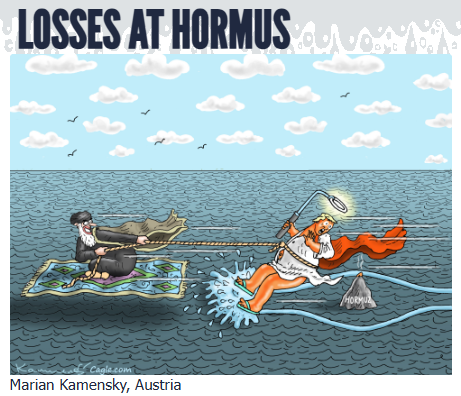
Note. From Losses at Hormuz [Editorial cartoon], by M. Kamensky, 2026b, Cagle Cartoons
(https://cagle.com/cartoonist/marian-kamensky/2026/09/14/311052/losses-at-hormus).
Copyright 2026 by Marian Kamensky.
Figure 12
Trump Pledge
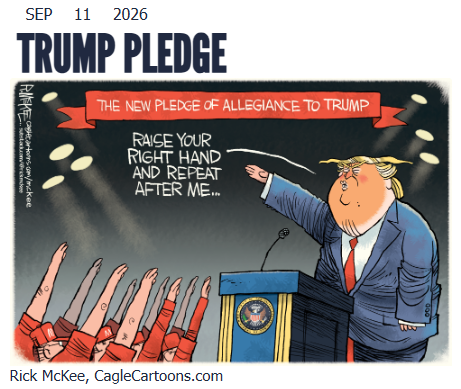
Note. From Trump Pledge [Editorial cartoon], by R. McKee, 2026, Cagle Cartoons
(https://cagle.com/cartoonist/rick-mckee/2026/09/11/311030/trump-pledge).
Copyright 2026 by Rick McKee.
