Inherited Places: What Happens When Everything Is America?
Greetings From Quebec
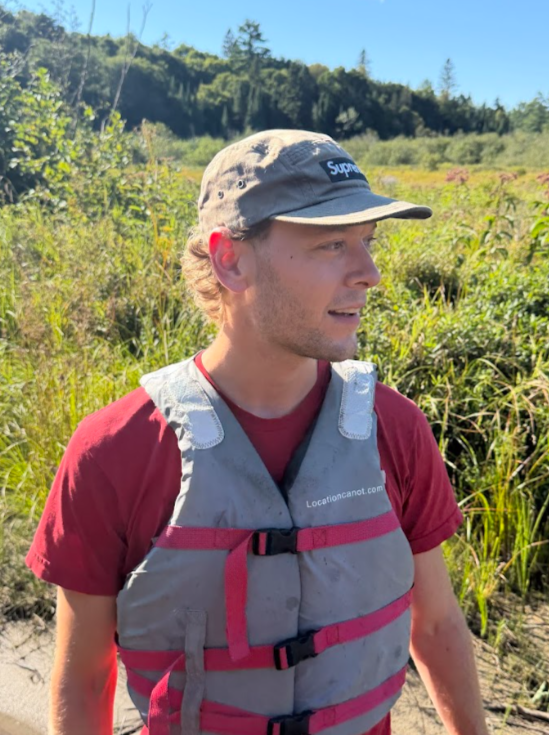
Photo: Wilson Ahrens, currently in Quebec, Canada.
Google Maps pinged my location as Saint-Mathieu-du-Parc, Quebec, Canada when I opened the app. I dragged the map southwest with my thumb, following the St. Lawrence past Trois-Rivières and Montreal. Something must have told Google that I am an American, because there it was in sans serif typeface across the surface of the familiar blue oblong blob:
Lake America.
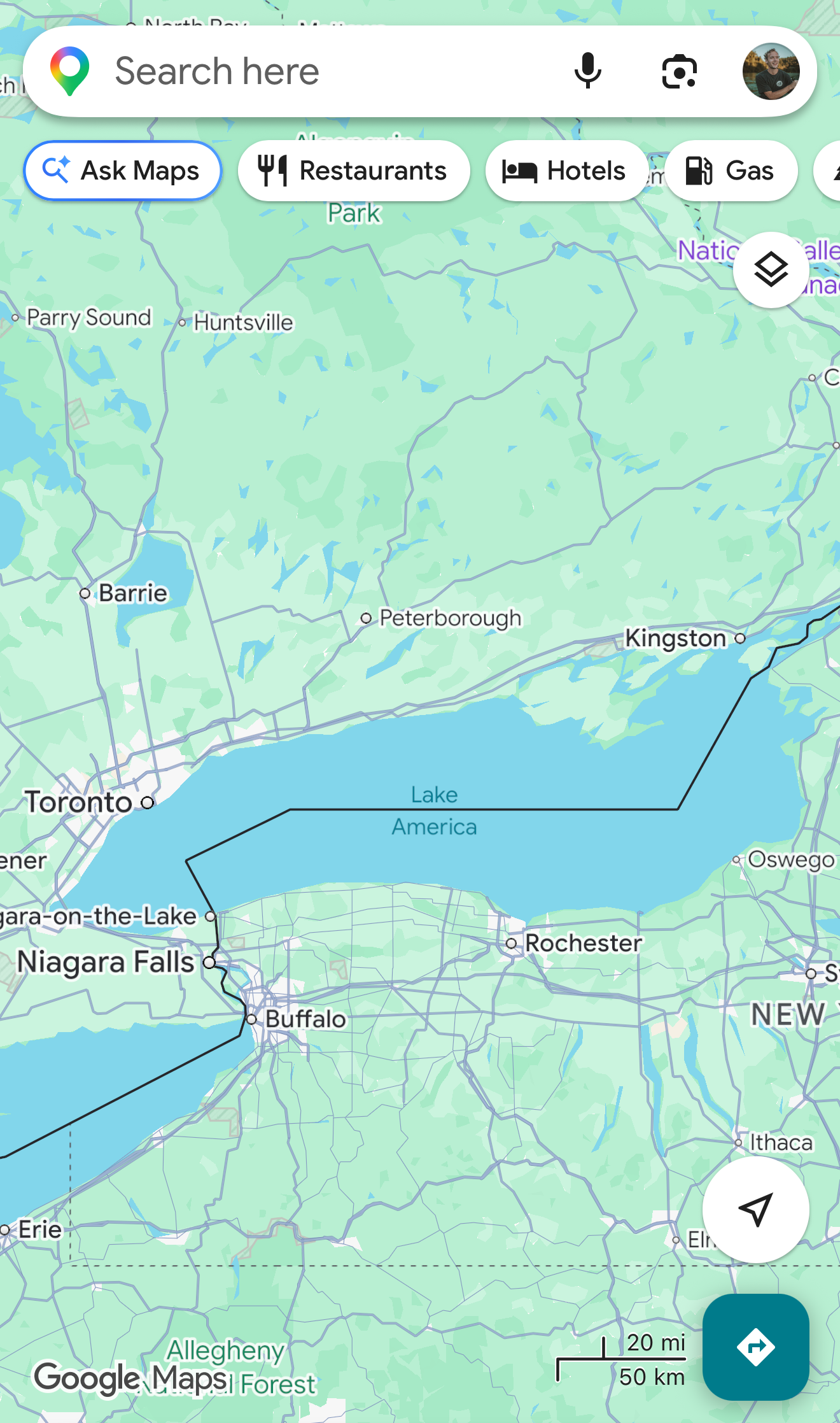
Screenshot: Google Maps labeled “Lake America” on my phone, Sept. 1.
I immediately hopped on my laptop and opened Maps there too. Again, it pinged my location. I dragged the screen southwest toward the same blob, and this time, in the same tiny font, it read the name I had expected:
Lake Ontario.
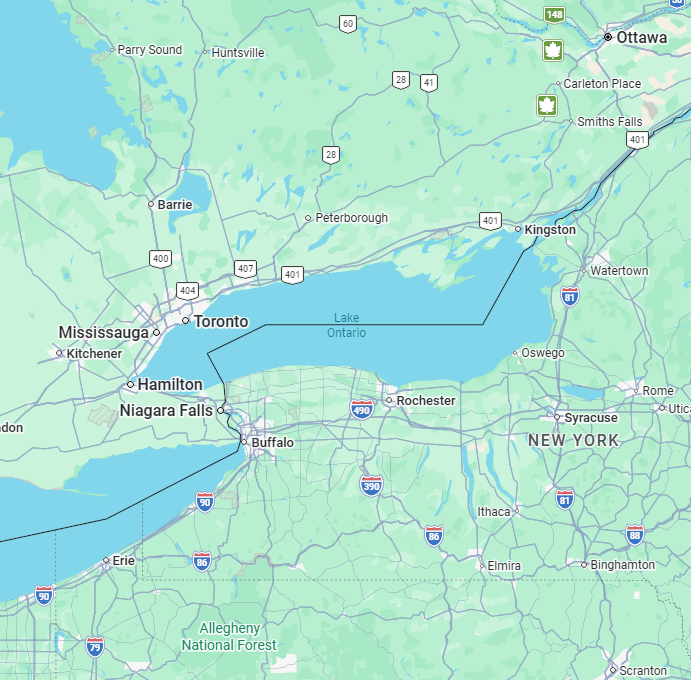
Screenshot: Google Maps labeled “Lake Ontario” on my laptop, Sept. 1.
A dark line divided the lake in half on both maps.
Last month, Canadian Prime Minister Mark Carney walked away from negotiations with President Donald Trump, asserting that a proposed trade deal compromised Canada’s sovereignty. Days later, on Aug. 27, 2026, Trump signed an executive order escalating the conflict from trade war to culture war.
Several familiar places stuck out. Ottawa. Toronto. Niagara Falls — I’d never realized there were three A’s in Niagara before — I’d always thought it was Niagra Falls. A slew of jokes suddenly made a lot less sense as I kept scanning: Rochester. Buffalo. Syracuse. Mississauga. Oswego. Napanee. Oshawa. And then I saw Mexico, oddly enough.
Mexico, New York.
Talk about south of the border, right?
I thought back to last year when Trump directed the federal government to use Gulf of America instead of Gulf of Mexico. I looked back over the map. It was eerie.
Oh, my bad, I misread that.
Erie.
It was Erie. Elmira. Ithaca. Huntsville. Watertown. Parry Sound.
Together, these names form a uniquely North American tapestry of Indigenous, European, national and local histories. This continent is recognizable precisely because those names remain distinct. Something about all of this scared me.
Imagine that you are America. That’s your name. Now think of a song that always gets stuck in your head. Your favorite hobby. Your childhood pet. The nickname your grandma used to call you. Picture the town you grew up in. Think of everything that makes you America.
Hold on to that.
America. America. America.
The Denali Problem
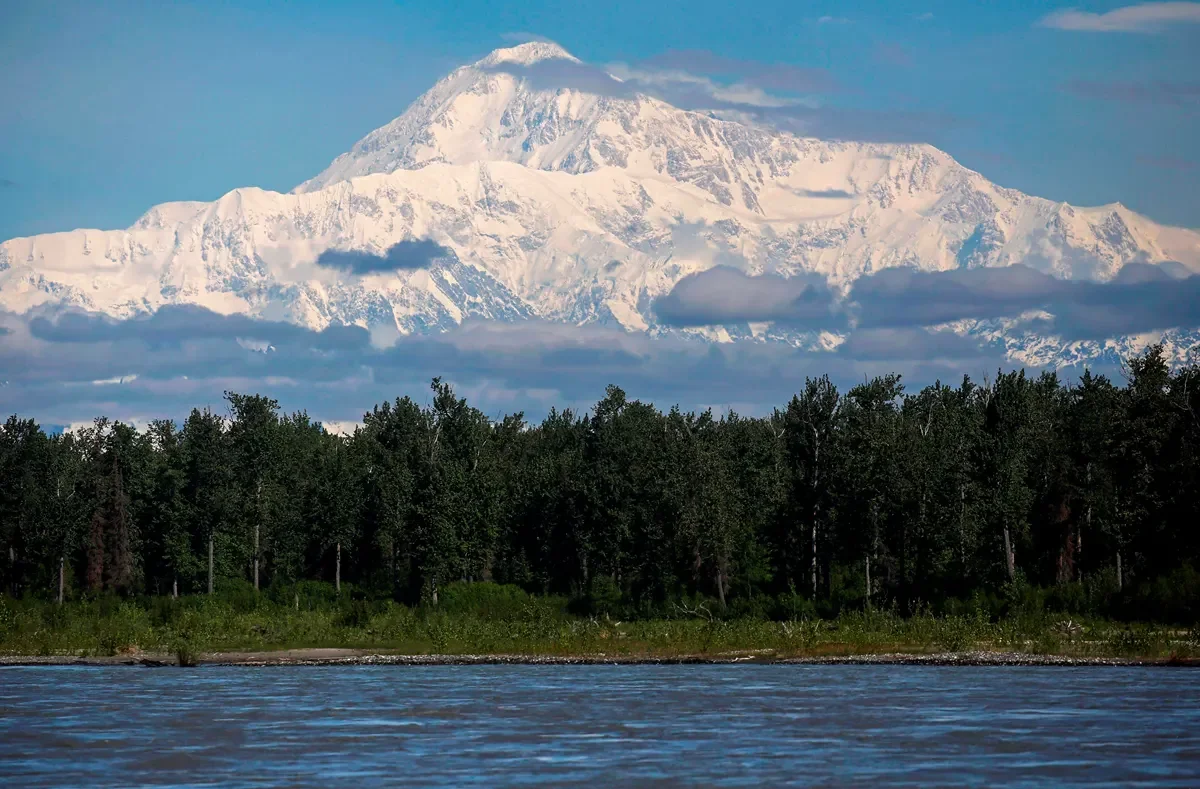
The view of the mountain from the south, in Talkeetna, Alaska NPS Photo / Emily Mesner
Russian explorers called it Bulshaia Gora.
Yukon prospectors knew it as Densmore Peak.
But long before either, Athabascan peoples already had several names for the mountain, notably the Koyukon Deenaalee. Then, in 1896, gold prospector William Dickey started calling the mountain McKinley after his favored presidential candidate, William McKinley of Ohio. Of course, there is no objectively true name for anything on a map, but these overlapping histories have implications for what we call a place.
Because McKinley won.
And after his assassination, Congress established Mount McKinley National Park. The name had become inheritance, absorbed into a developing American identity, institutionalizing what began as one man’s political jab.
Even so, many Alaskans never stopped using Denali.
When Alaska gained statehood in 1959, questions of whose history would define the new state became harder to ignore. Many Alaskans argued that Denali was an “originally Alaskan” name more deeply rooted in local history and culture. (Not to mention it’s objectively superior.)
The point is, Alaskans asked for Denali.
For decades.
Ohio lawmakers, intent on preserving their state’s presidential namesake, successfully campaigned against the change for decades until 2015, when Denali was finally restored as the mountain’s federal name. Alas, the victory was short-lived. In 2025, Trump changed it back, framing Mount McKinley as a restoration of “American greatness.”
Mount McKinley draws an uncomfortable parallel to Lake America. Both began as political statements imposed on places that already had living names, carried by the communities that inherited them. Denali. Lake Ontario. Gulf of Mexico. No one had to manufacture their meaning.
That, to me, is the difference.
There was no comparable movement to rename Lake Ontario. Until a few weeks ago, there was no side to choose. America is made up of places that already have meaning to us and to others; it does not become more American by slapping its name on more of them, especially those we share with our neighbors.
What are we losing by flattening our inheritance into one word?
Denali. Ontario. Mexico.
Remember all those things that make you America.
A song that gets stuck in your head.
The town you grew up in,
We may remember it differently, but at least — until recently — we could agree on the same name.
