Like Mother, Like Son
Final Project
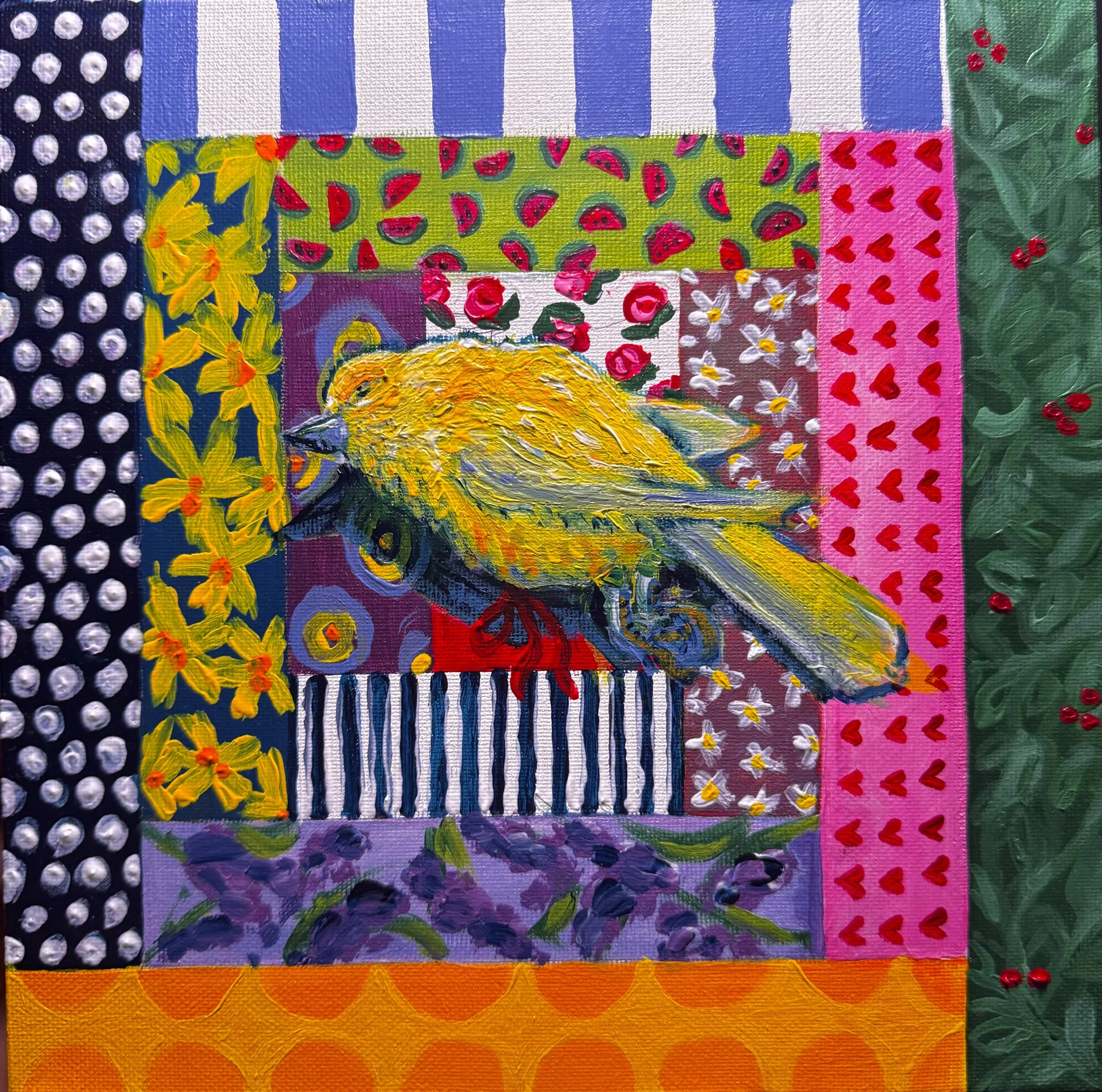
Acrylic on canvas, April 2024
The below artist statement was originally submitted with the artwork for my English 112L class in 2024. I was travelling in Montenegro when I created and submitted the piece, so I’ve included it as a delayed dispatch.
Susan Glaspell’s Trifles is set 100 years in the past, but the message transcends time and is relevant to the experiences of modern women. I grew up watching my mother. She worked two jobs and went to college while cooking, cleaning, and caring for our family. I remember nights when I would wake up to the sounds of shouting. I’d wait until there was silence and walk out onto the back porch, where she would have her head between her knees, sniffing back sadness.
She would grab me and hold me in her lap and say, “I love you, bud.” We would sit quietly in the dark, listening to the crickets until it was late. She’d take me back to bed and tuck me in. In the morning, I’d wake up to the smell of pancakes and bacon in the kitchen. Mrs. Wright had no children in the play, so she stitched a log cabin quilt pattern to pass her days. I believe that we were my mother’s quilt, my sister and I.
My mother and I are very similar. I am a spitting image of her. Very idealistic and charismatic. We like to make people laugh and to laugh ourselves. But we often seek outside validation. And yet as Mrs. Hale says about women, “We live close together and we live far apart. We all go through the same things—it’s all just a different kind of the same thing.” (p. 574, Line 6). Can also be applied to our relationship.
Growing up queer in the deep south, I felt much like the women in my life. I was raised by them, and I had more in common with them than with the men in my life. I started to express myself in certain ways, and when they manifested, they were quickly pruned. Too effeminate. In a similar way to my mother, over the years, I lost some parts of myself. I craved acceptance, all the while also pretending to be someone else just to survive.
I see both my mother and I reflected in the story of Mrs. Wright. Trapped and silent within our own homes. We both lost parts of ourselves, silenced like the canary. Luckily, our stories do not end the same as Mrs. Wright’s; we have had the opportunity to heal. And I’ve used this project to honor our struggles and the struggles of people like us. This painting is a tribute to the damaged parts of ourselves. I used acrylic paints on canvas to create a colorful log pattern cabin with my own variety of messages hidden within it.
Lying atop the square is a strangled canary. In the center below is a little red string to show that the square has been ‘knotted’, as mentioned in the play. I started painting to express myself. To put my emotions in the physical world. I view my art and what I do as a manifestation of what I’ve gone through. The painting is a mourning of sorts. But for the piece itself to be bright and colorful is to show that there can be beauty in pain. The act of creating the physical piece represents that there can be life after it.
Reference: Glaspell, Susan. Trifles. 1916.
